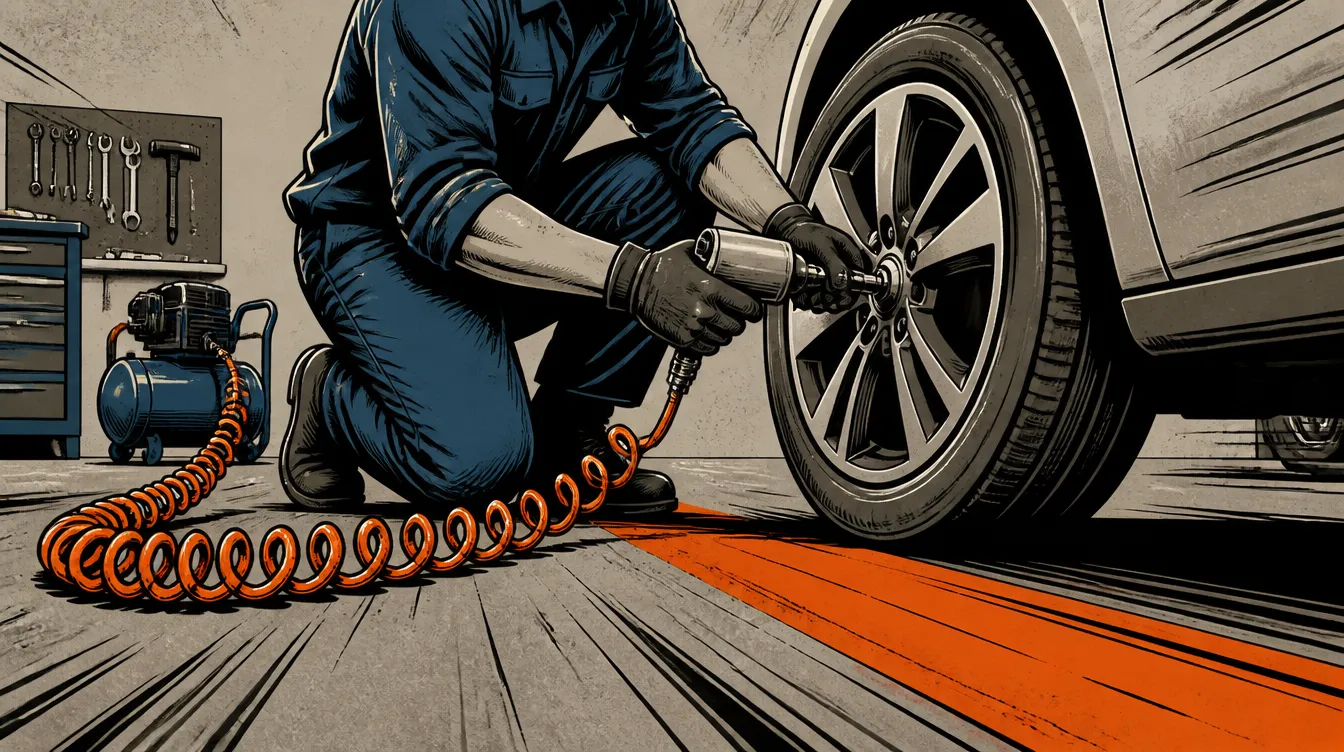
A pneumatic impact wrench, powered by a shop air compressor rather than a battery, is still the choice of a lot of professional mechanics for continuous, all-day use in a fixed shop setting. No dedicated pneumatic or air-driven impact wrench shootout exists in the testing corpus behind this guide. What does exist is a genuinely rigorous, hands-on comparison of 13 cordless electric impact wrenches, a different power source but the exact same underlying question a pneumatic wrench buyer needs answered: how much of the torque printed on the spec sheet actually shows up when a real bolt is on the line.
What the testing showed
The numbers below come from Project Farm's cordless impact wrench comparison, a 13-tool test. Every tool in this comparison is battery-powered, not pneumatic, so this guide is upfront that no air-driven wrench was part of the cited test, but the loosening-torque and driving-speed measurements it produced are the same categories that matter for a pneumatic wrench purchase.
The lineup included Milwaukee M12 Fuel, Flex, DeWalt Atomic, Greenworks, Kobalt, Ryobi 1+ HP, Seesii, Avhrit, Ridgid, Skil, Milwaukee M18 Fuel, Makita, and Snap-on, ranging from 70 to 746 dollars. No single tool won every category tested.
Loosening torque, the number that matters most for stuck fasteners
Measured as clamp load on a 3/4 inch bolt and converted to foot-pounds, the Milwaukee M12 Fuel topped the field at 341 ft-lb, followed by the Snap-on at 315 ft-lb and the Flex at 305 ft-lb. At the bottom, the Greenworks, the cheapest tool in the test at 70 dollars, produced only about 104 ft-lb, a third of the top performer's figure.
That spread, over 3 times between the strongest and weakest tools, is exactly the kind of gap a pneumatic wrench buyer needs to watch for too, since air tool torque ratings are just as prone to inflated marketing as cordless tool ratings.
Speed and repeated-use performance
On the timed test of driving three 5-inch lag bolts back to back, the Flex averaged the fastest time at 7.58 seconds, with the Milwaukee M12 Fuel close behind at 7.96 seconds. The Snap-on, the most expensive and traditionally professional-grade tool in the lineup at 746 dollars, averaged 9.48 seconds, a real reminder that the highest price does not automatically mean the fastest tool for every task.
How to read this for your own purchase
Since no pneumatic wrench was part of any cited test, use this cordless data to inform the questions to ask about any air impact wrench, particularly around verified torque and speed rather than headline spec numbers.
A pneumatic wrench's torque rating depends heavily on your compressor's CFM output, not just the tool's own spec. An air impact wrench rated for a certain torque figure assumes a specific CFM delivery at a specific PSI; an undersized compressor will never let the tool reach its rated output, a consideration that does not apply to a battery-powered tool with its own dedicated power source.
Verified, independently tested torque figures are more trustworthy than a spec sheet claim, exactly as this cordless comparison demonstrated, where claimed torque figures and measured clamp-load results did not always match closely across the 13 tools tested.
Factor in your compressor's real CFM output before choosing a pneumatic wrench's torque tier. Just as this cordless test showed a roughly threefold spread in loosening torque across the 13 tools, air impact wrenches also span a wide torque range, and an undersized shop compressor will cap a high-torque pneumatic wrench well below its rated output regardless of how strong the tool itself is on paper. Size the compressor to the wrench, not the other way around.
A few universal rules the cordless data supports for any impact wrench purchase, pneumatic included:
- The most expensive tool is not automatically the fastest or highest-torque option. The Snap-on, the priciest tool in this test at 746 dollars, was outpaced on driving speed by both the Flex and the Milwaukee M12 Fuel.
- Torque claims should be verified against an independent measurement wherever possible, since this test showed real gaps between what tools claimed and what they actually produced under load.
- Match the tool to the actual job. A tool that excels at raw breakaway torque is not necessarily the fastest at repeated, lower-torque fastening tasks, and the reverse is also true, as this comparison demonstrated across its 13 tools.
Ask about the tool's air consumption rating in CFM at your working PSI, not just its torque figure, since that is the number that determines whether your existing compressor can actually keep the wrench running continuously rather than starving it mid-job. A high-torque pneumatic wrench paired with an undersized compressor will underperform its rated output in exactly the way several budget cordless tools in this test underperformed their own printed torque claims.
Browse the rest of the power tools tests for more cordless and shop tools measured on real torque and speed numbers.