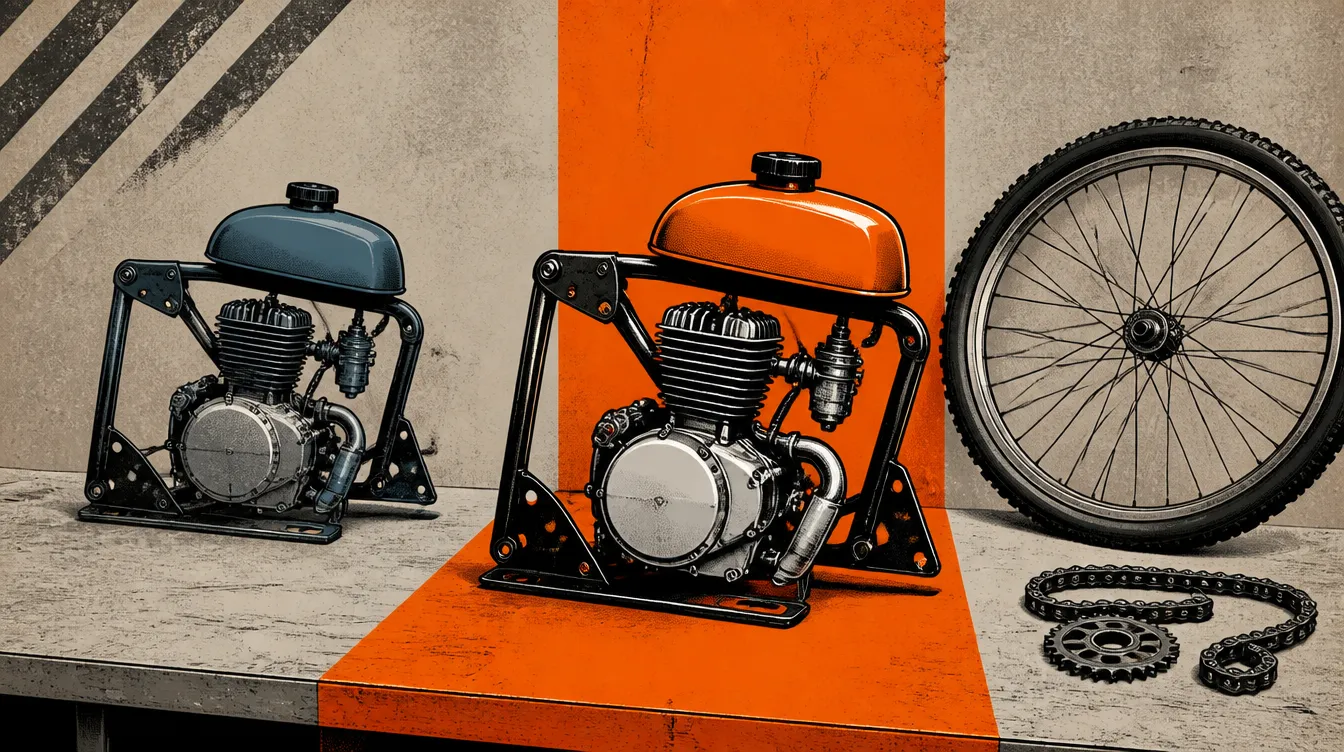
Which Bicycle Engine Kit Brand Wins?
This head-to-head test of 2 bicycle engine kit options has the measured results for each. See how they ranked and watch the full test video.

2-stroke bike engine kit
Price shown in test: around $100 to $120 (per this video's recap); the earlier, separate video that built and tested this same kit lists it at $120
Affiliate link. We may earn a commission at no extra cost to you.
The measured results
Every number below is read straight from the test. Products are listed in the order they finished.
All measurements (10 more)+
Displacement/power
- 14-stroke bike engine kit 49cc/50cc, overhead valve, centrifugal clutch, pull start50cc
about 1.6 horsepower, smaller displacement and less power than the two-stroke kit
- 22-stroke bike engine kit
advertised as 80cc but narrator states it is actually only 66cc, still larger than the four-stroke's 50cc; produces about 2.5 horsepower, more power than the four-stroke despite being a physically smaller engine
Top speed
- 14-stroke bike engine kit 49cc/50cc, overhead valve, centrifugal clutch, pull start37 mph
out of the box with no modifications
- 22-stroke bike engine kit
described only as "equally impressive" compared to the four-stroke kit's 37 mph; no exact top speed figure is given in this transcript (it would have been measured in the earlier, separate two-stroke build video)
Starting
- 14-stroke bike engine kit 49cc/50cc, overhead valve, centrifugal clutch, pull start
pull start, typically only 1 to 2 pulls to start, started on the second pull right out of the box
- 22-stroke bike engine kit
no pull start or kick start; requires getting the bike rolling first and then releasing the clutch to start the engine
Exhaust
- 14-stroke bike engine kit 49cc/50cc, overhead valve, centrifugal clutch, pull start
very clean burning, no exhaust smoke
- 22-stroke bike engine kit
produces noticeably more exhaust smoke, a common complaint the narrator references from viewers
Noise
- 14-stroke bike engine kit 49cc/50cc, overhead valve, centrifugal clutch, pull start
very quiet compared to the two-stroke kit
- 22-stroke bike engine kit
louder than the four-stroke kit
Drivetrain
- 14-stroke bike engine kit 49cc/50cc, overhead valve, centrifugal clutch, pull start
has a centrifugal clutch, so twisting the throttle alone gets the bike moving with no manual clutch needed
- 22-stroke bike engine kit
requires a manual clutch to start moving, to shift, and to stop
Smoothness
- 14-stroke bike engine kit 49cc/50cc, overhead valve, centrifugal clutch, pull start
very smooth running, hardly vibrates even at higher speeds
- 22-stroke bike engine kit
vibrates quite a bit at higher speeds
Weight/install
- 14-stroke bike engine kit 49cc/50cc, overhead valve, centrifugal clutch, pull start
heavier than the two-stroke kit (about twice as much) and more difficult to fit into the bicycle frame due to less available space
- 22-stroke bike engine kit
about half the weight of the four-stroke kit and much easier to fit into the frame due to more available space
Drivetrain compatibility
- 14-stroke bike engine kit 49cc/50cc, overhead valve, centrifugal clutch, pull start
required replacing the factory crank arm and front sprocket to fit, at the cost of 3 of the bicycle's original gears (traded down to 1)
- 22-stroke bike engine kit
does not require replacing the factory crank arms or front sprocket, so none of the bicycle's original gears are lost and the bike can still be pedaled normally with or without engine assist
Fuel efficiency
- 14-stroke bike engine kit 49cc/50cc, overhead valve, centrifugal clutch, pull start
narrator states he gets better fuel efficiency riding this kit than the two-stroke kit, based on his own riding experience rather than a measured figure
- 22-stroke bike engine kitnot tested
How it was tested
- physical installation/build complexity (frame clearance, crank arm and sprocket compatibility)
- engine starting method and ease of starting
- exhaust smoke output
- noise level
- top speed test (measured explicitly only for the four-stroke kit in this video, at 37 mph)
- fuel efficiency (subjective, based on the narrator's own riding experience rather than a measured test)
- ride smoothness/vibration at higher speeds
- power and displacement comparison
Data notes and caveats
This video explicitly declines to pick one overall winner: "So which engine kit is better, the two-stroke kit or the four-stroke kit? I really think that depends on what you're looking for," followed by 5 named advantages of the two-stroke kit and 6 named advantages of the four-stroke kit; winner/runnerUp/verdictQuote are left null per the standing rule against forcing a winner on a depends-on-your-needs verdict. budgetPick is set to the 2-stroke kit since it is both cheaper ($100 to $120 versus $189) and explicitly named as having a price advantage by the narrator. Neither product is a named commercial brand, both are generic 2-stroke and 4-stroke bicycle engine conversion kits as described in the video's Products Tested list. A meta chapter titled "25% larger displacement" does not exactly match the spoken 66cc vs 50cc figures (a 32 percent difference by that math), suggesting the on-screen graphic during that segment may show a different or more precise number than what is stated in the transcript; not resolved further. The two-stroke kit's exact top speed is never stated in this video's transcript, only described qualitatively as "equally impressive" to the four-stroke's measured 37 mph; that figure would have been established in an earlier, separate two-stroke build video referenced in the description.
More Myths & Experiments
Which Fuel Saving Devices Brand Wins?
Reduced speed plus increased tire pressure
See the results
Which Diesel Fuel Alternative Brand Wins?
5 products tested
See the results
Which Turpentine As Engine Fuel Additive Brand Wins?
2 products tested
See the results