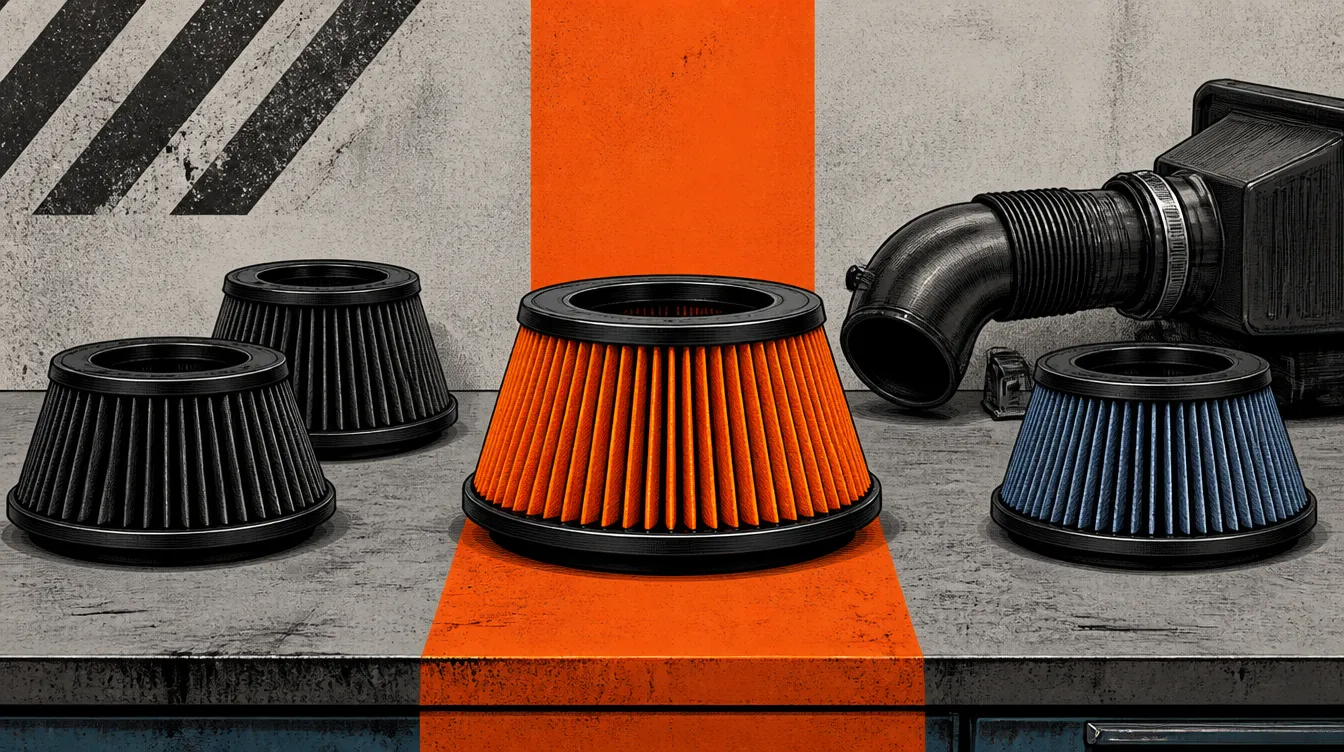
Which Car Air Filter Brand Wins?
This head-to-head test of 6 car air filter options has the measured results for each. See how they ranked and watch the full test video.
EPAuto
Price shown in test: $8.87
Affiliate link. We may earn a commission at no extra cost to you.
The quick take
No single winner was declared in this test. Here is where the top-ranked pick landed, straight from the measured results.
Best in 1 of 2 measurements, including 0-60mphTest.
The measured results
Every number below is read straight from the test. Products are listed in the order they finished.
Construction
- 1EPAuto80 pleats
(most of any filter tested), 2 layers of adhesive, 507 grams
- 2Fram Extra Guard76 pleats
3 layers of adhesive, 441 grams, larger pleat hole size than EPAuto
- 3AC Delco76 pleats
3 different adhesive applications, mesh offset in three areas, 577 grams (heaviest filter tested)
- 4Purolator One75 pleats
a few lines of adhesive, part of the filter media appeared pressed, 451 grams
- 5WIX72 pleats
(fewest of any filter), no adhesive applied to the filter media (unlike all other brands), four areas of wire mesh extending outward, 413 grams (lightest filter tested)
- 6K&N32
layers of oiled cotton, wire mesh integrated directly into the filter media (different design than the paper filters), 516 grams, noted as 'very oily right out of the packaging'
New Filter Airflow
- 1EPAuto
static pressure 2.76 in H2O, airspeed 54.7 mph (baseline with no filter: 59.4 mph airspeed, about 0.96 in H2O static pressure)
- 2Fram Extra Guard
static pressure 2.75 in H2O, airspeed 54.9 mph (best airspeed among filters until K&N was tested)
- 3AC Delco
static pressure 3.03 in H2O, airspeed lower than Fram's 54.9 mph (exact mph not stated)
- 4Purolator One
static pressure 3.09 in H2O, airspeed 54.6 mph (slower than Fram)
- 5WIX
static pressure 4.07 in H2O (highest/most restrictive of any filter before K&N... actually the single highest new-filter static pressure of all six), airspeed 52.1 mph (lowest of any filter)
- 6K&N
static pressure 1.72 in H2O (lowest/best of all filters, and lower than the no-filter control's own 0.96 baseline once considered relative to the paper filters), airspeed 57.39 mph (highest/best of all filters)
0-60mphTest(2003 Suburban, best of 2 runs)
- 1EPAuto9.4s
and 9.4s, best 9.4s, initially the time to beat
- 2Fram Extra Guard9.5s
and 9.5s, best 9.5s (chapter metadata confirms '9.5 seconds average & best time'), slightly slower than EPAuto
- 3AC Delco9.4s
and 9.6s, best 9.4s, matched the fastest time at that point in testing
- 4Purolator One9.8s
and 9.4s, best 9.4s, matched the fastest time despite a notably slow first run
- 5WIX9.4s
and 9.3s, best 9.3s (chapter metadata confirms 'Best 9.3, average 9.35')
- 6K&N9.3s
and 9.2s, best 9.2s, the fastest time of any filter tested
ContaminationTest(smallParticles 1-5 micron)
- 1EPAuto
phase 1 (flour spread) +107; phase 2 (half-second air pulse) 165; phase 3 (1 min continuous airflow) 587
- 2Fram Extra Guard
phase 1 173; phase 2 361 (more than twice EPAuto's phase-2 count); phase 3 697
- 3AC Delco
phase 1 76 (better than EPAuto and Fram); phase 2 326 (better than Fram, not as good as EPAuto); phase 3 697 (tied with Fram)
- 4Purolator One
phase 1 count actually decreased by 13 from the baseline in the test box; phase 2 increased to 116 (best of all filters at this phase); phase 3 increased by 468
- 5WIX
phase 1 count decreased by 2 from baseline; phase 2 increased by 43 (best of all filters at this phase); phase 3 peaked at 401
- 6K&N
phase 1 3604 (by far the worst of any filter, orders of magnitude above the others); phase 2 572; phase 3 407
ContaminationTest(largeParticles 5+ micron)
- 1EPAuto
phase 1 +76; phase 2 61; phase 3 26
- 2Fram Extra Guard
phase 1 126 ('next to last' place); phase 2 252 (about four times EPAuto's phase-2 count); phase 3 166 (worst/last place of all six filters)
- 3AC Delco
phase 1 58; phase 2 182; phase 3 157 ('next to last' place, just ahead of Fram)
- 4Purolator One
phase 1 unchanged from baseline (essentially 0 particles got through); phase 2 increased by only 35 (best of all filters at this phase); phase 3 increased by 14
- 5WIX
phase 1 count decreased by 1 from baseline (essentially 0 particles got through); phase 2 increased by 18 (best of all filters at this phase); phase 3 did not increase at all (0, best of all filters)
- 6K&N
phase 1 2972 (worst of any filter, 'really struggled'); phase 2 421 (worst of any filter at this phase); phase 3 5
Static Pressure After Contamination
- 1EPAuto
increased from 2.76 to about 3.49, the lowest (best) final static pressure of all six filters
- 2Fram Extra Guard
increased from 2.75 to a figure captioned '23.82', almost certainly a caption-mangled decimal for approximately 3.82 based on the closing ranking (EPAuto best, then K&N, then Fram); kept the literal caption value and flagged rather than silently corrected
- 3AC Delco
increased from 3.03 to 4.18
- 4Purolator One
increased from 3.09 to 4.48, one of the two highest post-contamination pressures, framed by the narrator as evidence of superior contamination trapping
- 5WIX
increased from 4.07 to 6.63, the highest post-contamination pressure of any filter, framed by the narrator as evidence of the best contamination trapping
- 6K&N
increased from 1.72 to a figure captioned '2 3.79' (rendered here as '23.79'), almost certainly a caption-mangled decimal for approximately 3.79 based on the closing ranking placing K&N second-best behind EPAuto for post-contamination static pressure; kept the literal caption value and flagged rather than silently corrected
How it was tested
- baseline (no filter) static pressure and airspeed measurement
- new-filter static pressure and airspeed measurement
- 0-60 mph acceleration test in a 2003 Chevrolet Suburban, two timed runs per filter, best time counted
- particle contamination test with a particle counter tracking 1-5 micron ('small') and 5+ micron ('large') particles across three phases: after spreading 1/2 cup of flour on the filter, after a half-second air pulse, and after one minute of continuous airflow
- static pressure change from clean to contaminated filter
- filter construction comparison (pleat count, weight, adhesive layers, wire mesh design)