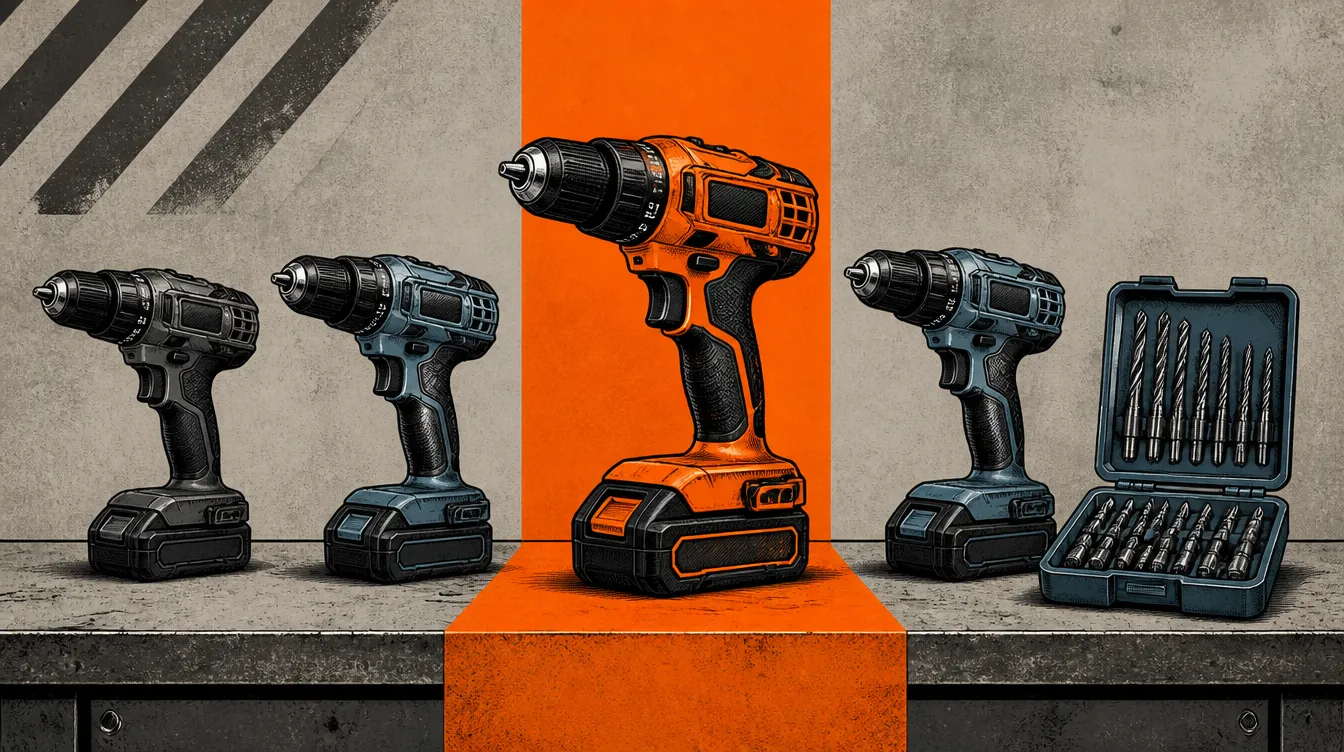
Which Cordless Drill Brand Wins?
This head-to-head test of 8 cordless drill options has the measured results for each. See how they ranked and watch the full test video.

Bauer
Price shown in test: $45 for just the drill, not battery and charger; least expensive brand tested
Affiliate link. We may earn a commission at no extra cost to you.
The measured results
Every number below is read straight from the test. Products are listed in the order they finished.
Specs
- 1Milwaukee
claims up to 60% more power and up to 1.5 in shorter length vs a comparison model, up to 2x faster speed under heavy load claimed, peak torque claim 1200 in-lb, up to 2000 RPM claimed, 5-year warranty, made in Vietnam, brushless motor
- 2DeWalt
brushless motor, 3 speeds, max power claim of 820 unit watts out, up to 2000 RPM claimed, 11 clutch settings, 3-year warranty, made in USA with global materials
- 3Makita
claimed most powerful drill in the lineup at 1090 in-lb torque, brushless motor, up to 2100 RPM claimed, made in China
- 4Bauer20V
Hypermax lithium, claimed high performance motor and all-metal gear construction, claimed max torque 450 in-lb, claimed RPM 0 to 450 and 0 to 1700, guaranteed for 90 days, made in China, brushed motor (only brushed-motor drill in the lineup)
- 5Ryobiup to500 in-lb
torque claimed, 0 to 450 and 0 to 1750 RPM claimed, 3-year warranty, made in China, brushed motor; ships with a 1.5 amp-hour battery but was tested with a 4 amp-hour battery for consistency with the other brands
- 6Ridgid
brushless motor, up to 650 in-lb torque claimed, lifetime warranty, claimed micro-clutch premium clutch design with over 100 settings, claimed diecast gearbox for extended durability, comes with a handle, made in China
- 7Bosch
brushless motor, max RPM 2100 claimed, max torque 755 in-lb claimed, made in Malaysia, comes with a handle
- 8Festool
max torque 531 in-lb claimed, made in Czech Republic, battery made in China, charger made in Germany, brushless motor, claimed to spin nearly twice as fast as the competition at 3800 RPM in mode four, chuck can be removed and a driver installed, manufacturer website claims it 'will stand up to anything you can possibly throw at it or throw it at'
Light
- 1Milwaukee
LED stays on 10 seconds after trigger release
- 2DeWalt3
light settings; offers by far the brightest light on the highest setting of all brands
- 3Makita
two LEDs, stay on 10 seconds after trigger release
- 4Bauer
single LED, stays on 4 seconds after trigger release, shortest light duration in the lineup
- 5Ryobi
only stays illuminated while the trigger is engaged, no delay unlike every other brand tested
- 6Ridgid
stays on 10 seconds after trigger release
- 7Bosch
stays on 10 seconds after trigger release
- 8Festool
four LEDs, activated only by pressing a separate button next to the lights, unlike every other brand's automatic trigger-linked light
Weight
- 1Milwaukee4 lb
11.4 oz, nearly the same as DeWalt
- 2DeWalt4 lb
10 oz
- 3Makita
by far the heaviest drill at 5 lb 2 oz (82 oz per the closing weight comparison, heaviest of all 8 brands)
- 4Bauer
lightest tool of all 8 brands at 64 oz (3 lb 15.8 oz with a 3 amp-hour battery)
- 5Ryobi4 lb
3.9 oz
- 6Ridgid4 lb
7 oz, heaviest at that point in the intro sequence
- 7Bosch4 lb
9.2 oz, only a couple ounces less than Milwaukee and DeWalt
- 8Festool4 lb
10.3 oz, nearly the same as DeWalt and Milwaukee
Length
- 1Milwaukee
shortest drill in the lineup at only 7 in
- 2DeWalt
very close to 8 in
- 3Makita
very close to 8 in, about the same as DeWalt
- 4Bauer7.75 in
- 5Ryobi8.25 in
slightly longer than Bauer
- 6Ridgid7.25 in
shortest at that point in the intro sequence (later surpassed only by Milwaukee's 7 in)
- 7Bosch7.75 in
- 8Festool9 in
the longest drill in the lineup
Noise
- 1Milwaukee
tied with Ridgid for loudest baseline at 83 dB; electronic clutch quiet at 70 dB
- 2DeWalt81 dB
baseline, slightly quieter than Ridgid; electronic clutch only 73 dB, much quieter than the Bauer/Ryobi/Ridgid mechanical clutches
- 3Makita
very close to 80 dB baseline; mechanical clutch is the loudest of all 8 brands at 102 dB
- 4Bauerclose to80 dB
baseline; mechanical clutch loud at 100 dB
- 5Ryobi78 dB
baseline, slightly quieter than Bauer; mechanical clutch 99 dB, slightly quieter than Bauer's
- 6Ridgid83 dB
baseline, loudest at that point in the intro sequence (later tied by Milwaukee); mechanical clutch loud at 100 dB
- 7Bosch
quietest baseline of all 8 brands at 77 dB; unusual design where the electric motor also powers down when the mechanical clutch is activated; clutch measured at 98 dB
- 8Festool
quietest drill of all 8 brands at 73 dB baseline; electronic clutch also quiet at around 70 dB
Low RPM Control Test
- 1Milwaukee35 RPM
described as 'pretty good' but not the best in the field
- 2DeWalt
very good at only 23 RPM
- 3Makita
same as DeWalt at 23 RPM
- 4Bauer27 RPM
did very well on the lowest torque setting (no reading below 0 in-lb)
- 5Ryobi
best low-RPM control of the mechanical-clutch brands at only 19 RPM, 'even better low RPM control than the Bauer'
- 6Ridgid
very good at only 27 RPM
- 7Bosch
best low-RPM control of all 8 brands at only 7.3 RPM
- 8Festool
very good at only 11 RPM
No Load RPM Vs Rating
- 1Milwaukeeabout30 RPM
short of its 550 first-gear rating; nearly 200 RPM short of its second-gear rating
- 2DeWalt
made 453 RPM vs a claimed 450 first-gear rating; exceeded its 1300 second-gear rating by 40; slightly beat its 2000 RPM rating at 2011
- 3Makita
very close to its 550 first-gear rating; slightly over its 2100 second-gear rating at 2111
- 4Bauer
beat its own 450 RPM first-gear rating at 465; beat its 1700 RPM second-gear rating at 1733
- 5Ryobi
came very close to its 450 RPM first-gear rating; about 90 RPM short of its 1700 RPM second-gear rating
- 6Ridgid
very close to its 550 RPM first-gear rating; a little over 100 RPM short of its 2100 RPM second-gear rating
- 7Bosch
came up a little short of its 480 RPM first-gear rating at 433; nearly 200 RPM short of its 2100 RPM second-gear rating
- 8Festool
slightly over its 400 RPM first-gear rating at 404; beat its 850 RPM second-gear rating; over its third-gear rating by nearly 100; beat its fourth-gear 3800 RPM rating by 75
Clutch Torque Range Test
- 1Milwaukee
lowest setting 136 in-lb ('definitely not a tool for delicate work'); highest setting (level 14) 231 in-lb
- 2DeWalt
lowest setting 76 in-lb, 'definitely not a good setup for delicate work' (electronic clutch); highest setting (level 11) 245 in-lb
- 3Makita
lowest setting 0 in-lb, performed very well (mechanical clutch); highest setting 78 in-lb
- 4Bauer
lowest setting produced 0 in-lb (could not move the torque adapter off zero, the best possible low-end result); highest setting 141 in-lb, 'a pretty wide range of torque settings'
- 5Ryobi
performed well on the lowest torque setting (mechanical clutch); highest setting 114 in-lb
- 6Ridgid
lowest setting 0 in-lb, did very well; highest setting 180 in-lb
- 7Bosch
lowest setting 0 in-lb, did a great job (mechanical clutch); highest setting 69 in-lb, the lowest maximum clutch-torque figure of all 8 brands
- 8Festool
struggled on the lowest setting (electronic clutch) at 92 in-lb, 'definitely not a good setup for delicate work'; highest setting 151 in-lb
All measurements (4 more)+
Max Torque Test
- 1Milwaukee
won outright at 468 in-lb, 'just about drove the half-inch lag bolt all the way into the 4 by 4s'
- 2DeWalt403 in-lb2nd
second place behind Milwaukee, described as 'by far the best yet' at that point in the test order
- 3Makita348 in-lb3rd
'did very well... but that's not enough to take the lead from DeWalt'
- 4Bauer143 in-lb
seventh of eight, ahead of only Ryobi
- 5Ryobi131 in-lb
last of all 8 brands
- 6Ridgid226 in-lb
sixth of eight overall; briefly held the lead before being overtaken by DeWalt, Makita, and Milwaukee
- 7Bosch289 in-lb4th
- 8Festool250 in-lb5th
'made slow and steady progress, finally giving up'
Time Test First Gear
- 1Milwaukee5.51 seconds2nd
average, second place behind Makita's 5.24
- 2DeWalt5.83 seconds4th
close behind Ridgid's 5.8
- 3Makita
won outright at 5.24 seconds, 'the fastest yet'
- 4Bauer6.59 seconds
average, slowest measured at that point, 'definitely losing quite a bit of speed under load'
- 5Ryobi7.45 seconds
slowest of the field, 'definitely seemed to slow down more than the Bauer'
- 6Ridgid5.8 seconds3rd
'quite a bit faster than the Bauer and Ryobi'
- 7Bosch6.68 seconds
tied for slowest with Festool, 'around a second slower than Ridgid, DeWalt, Milwaukee, and Makita'
- 8Festool
tied for slowest with Bosch at 6.68 seconds; narrator switched from the labeled level four to level three for a comparable RPM to the other brands' first gear
Speed Test Highest Setting
- 1Milwaukee1.87 seconds3rd
in second gear, third place behind DeWalt (1.56) and Makita (1.84)
- 2DeWalt
won outright at 1.56 seconds in third gear, 'about half a second faster than the Ridgid'
- 3Makita1.84 seconds2nd
in second gear, second place behind DeWalt
- 4Bauerabout2 seconds
in second gear, came up about half an inch short of fully driving both bolts
- 5Ryobi2.25 seconds
in second gear, slower than Bauer; also came up about half an inch short of fully driving both bolts
- 6Ridgid2.04 seconds5th
in second gear, fifth place; 'completely drove in both bolts'
- 7Bosch2.02 seconds4th
in second gear, fourth place, moved ahead of Ridgid
- 8Festool2.47 seconds
at level three, slowest of all 8 drills; for reference, a Milwaukee Fuel impact driver tested at the same level averaged 2.88 seconds, slower than every drill including Festool
Endurance Test
- 1Milwaukee
'no issues with Milwaukee getting started and it lasted for 2 minutes'; transcript does not specify which gear it ultimately ran in for the full duration
- 2DeWalt
'had a little bit of a problem getting started, but once it got started, did just fine'; narrator ran it an extra 20 seconds to compensate for the slow start; gear used for the remainder is not explicitly stated
- 3Makita
shut off about halfway through the test in second gear; narrator switched it to first gear to finish
- 4Bauer
could not spin the engine over in second gear; survived the full 2-minute test in first gear
- 5Ryobi
could not spin the engine over in second gear; narrator notes it 'smells a little hot'; result in first gear not explicitly stated as pass or fail beyond that observation
- 6Ridgid
could not spin the engine over in second gear; finished the test in first gear
- 7Bosch
got started fine but shut down at 36 seconds in second gear; had to finish the test in first gear
- 8Festool
did not have enough power in third or fourth gear, so it was tested in second gear where it 'performed very well', unlike most other brands which had to drop to first gear
How it was tested
- low-speed/RPM control test (slowest RPM achievable without stalling)
- no-load RPM test in each gear vs manufacturer ratings
- clutch torque range test (lowest and highest clutch settings, inch-pounds)
- maximum torque test (driving a half-inch by 10-inch lag bolt into 4x4s)
- time test driving five lag bolts in first/low gear
- time test driving bolts in the highest speed setting available
- endurance test (spinning a braked, sparkplug-removed engine over for up to 2 minutes)
- noise level in decibels (baseline and with clutch engaged)
- weight and length
Brand head-to-head scoreboards featuring this test
Data notes and caveats
No single overall winner is declared and no numeric average-finish scorecard is given (unlike most other videos in this channel). The closing statement names three brands as recommended without ranking them against each other: 'I'm really impressed with the Milwaukee's torque as well as its compact size. However, the DeWalt as well as the Makita have their own strengths as well. I'd recommend any of those three brands.' winner and runnerUp are left null per the per-use-case/multi-pick rule; data quality itself is clean, so confidence remains high.