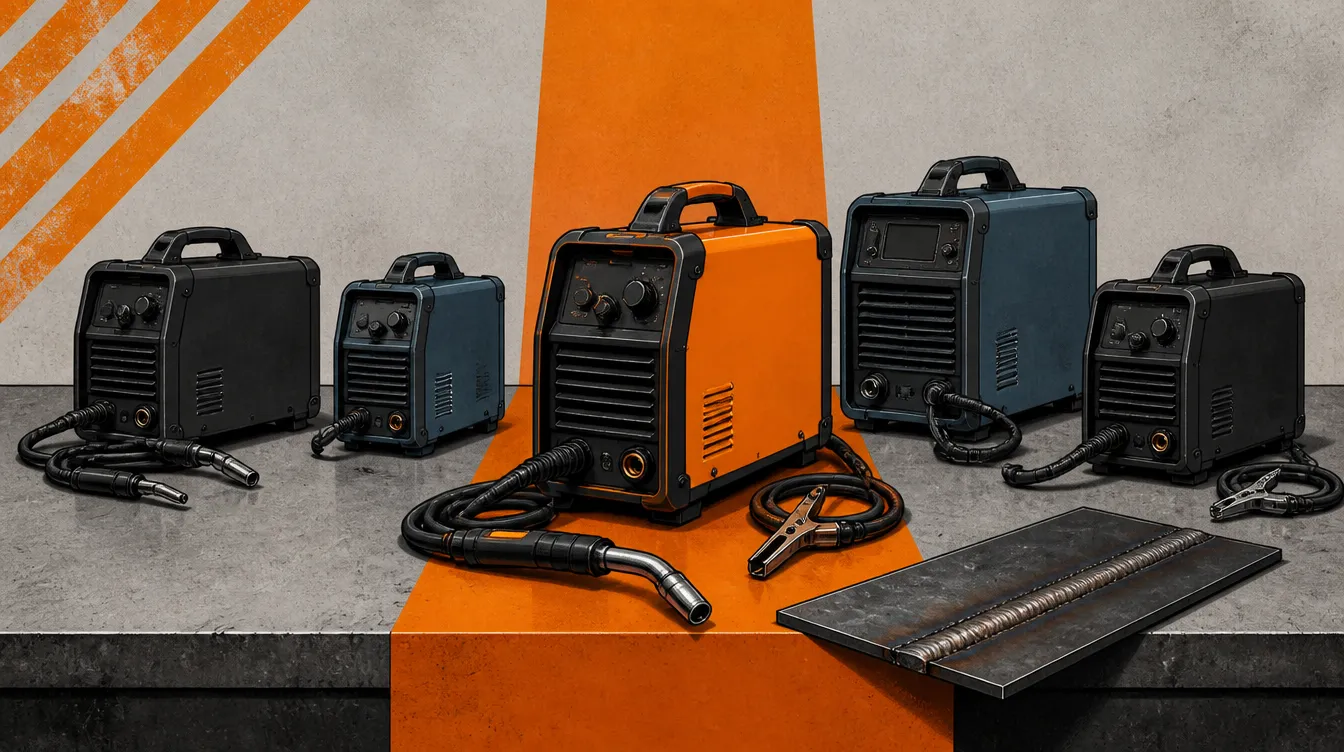
Which Welder Brand Wins?
This head-to-head test of 7 welder options has the measured results for each. See how they ranked and watch the full test video.

Hone
Price shown in test: $90
Affiliate link. We may earn a commission at no extra cost to you.
The quick take
The short version of why each pick lands where it does, built straight from the measured results.
Best in 2 of 4 measurements, including 120V current output and Max penetration test.
The measured results
Every number below is read straight from the test. Products are listed in the order they finished.
120V current output
- 1Lincoln 210
hot start 112 amps (within 1 amp of the multimeter, very close to the 100 amp target); max setting (115 amps) hot start 147 amps then tapered to 115 amps, right on target
- 2Titanium
spec max at 120V is 70 amps; hot start 83.7 amps settling to about 74 amps
- 3Hone
hot start 143 amps dropping back to 93 to 105 amps, the best result of the welders tested up to that point; max setting (140 amps): started at 144 amps, dropped to the mid-120s, called by far the best yet at that point
- 4Deko100 amp
setting: started at 87.9 amps, dropped to the mid-70s, not quite as good as the Hone; max setting (159 amps): started at 132 amps, quickly dropped to about 105 amps, the lowest constant output of the welders tested up to that point
- 5Yeswelder100 amp
setting: started at 81 amps, dropped to about 79 amps; highest setting on this dial (138 amps): held steady around 107 amps
- 6Ssimder100 amp
setting: peak of 68.2 amps, about 32 amps short; max setting (200 amps): ran out of steam at 123.3 amps, about 10 amps better than the S7
- 7S7100 amp
setting: peak of 73.1 amps, 27 amps short; setting dialed to 201 amps: peak of 113.7 amps, almost 90 amps short
240V current output
- 1Lincoln 210100 amp
setting: hot start 119 amps tapering to 99 to 100 amps, called very impressive; max setting (175 amps): hot start 206 amps tapering to and holding 173 to 175 amps until the metal burned through and the reading became erratic, called very consistent
- 2Titanium100 amp
setting (hard to set precisely on the analog dial): landed close at about 105 amps; max setting (225 amps): started near 245 amps and dropped to about 233 amps, a little hotter than advertised
- 3Hone100 amp
setting: running about 35 amps too hot; max setting (140 amps): in the upper 130s, called pretty accurate on the highest setting
- 4Deko100 amp
setting: mid to upper 90s, called a great result; max setting (160 amps): hot start around 170 amps dropping to the lower 140s
- 5Yeswelder100 amp
setting: upper 70s, more than 20 amps short; max setting (206 amps claimed): 159.6 amps, the most current produced yet at that point, called not bad for a $130 welder
- 6Ssimder100 amp
setting: only 69.2 amps, about the same as at 120V, did not take advantage of the higher voltage; max setting (200 amps): ran out of steam at 122.5 amps
- 7S7
not tested, the S7 does not come with a 240V adapter
Current accuracy
- 1Lincoln 210
most accurate welder tested at every setting: 100 percent at 100 amps and at max setting on both 120V and 240V; on the actual-vs-displayed current graph, described as right on target as expected from a very expensive welder
- 2Titanium100 amps
(120V): 107 percent; max (120V): 107 percent; 100 amps (240V): 107 percent, a little hot; max (240V): 104 percent; delivered the most current of any welder at the 240V max setting, 233 amps; on the actual-vs-displayed graph, the analog dial is called difficult for achieving precise settings
- 3Hone100 amps3rd
(120V): 105 percent, a little hot; max (120V): 91 percent, third place; max (240V): 99 percent; on the actual-vs-displayed graph, described as not doing too bad, off by less than 10 percent
- 4Deko100 amps2nd
(240V): 97 percent, second place; on the actual-vs-displayed graph, not too far off at lower current but becoming more inaccurate at higher settings
- 5Yeswelder
delivered the third most current of all welders at the 240V max setting, 159.6 amps; on the actual-vs-displayed graph, described as not quite as accurate as the Hone and Deko across the whole range
- 6Ssimder
on the actual-vs-displayed graph, described as a little bit better than the S7 but still quite a bit lower than the displayed setting
- 7S7
on the actual-vs-displayed graph, the worst of all welders tested, with actual current well below the displayed setting throughout
Max penetration test
- 1Lincoln 210about175 amps2nd
actual current, penetration 3.94 mm (second place behind Titanium), broke at almost 1,400 lb (about 1,398 lb, second place)
- 2Titanium
too much current for the 1/8in 7018 rod used (by design, this is a max power test), penetration derived as about 4.25 mm from the stated 2.1 mm of unfinished business (matches the closing recap's explicit 4.25 mm figure), the best of all welders; broke at 2,436 lb, by far the best yet
- 3Honeabout138 amps
actual current, best looking weld up to that point; 4.65 mm of unfinished business meaning about 1.7 mm of penetration, the best yet at that point; broke at just over 400 lb
- 4Dekoabout147 amps
actual current, nice looking weld, consistent arc; best penetration yet at that point at 2.15 mm; broke at 689 lb, more than twice the strength of the S7
- 5Yeswelderabout160 amps
actual current, terrific start with a very smooth arc pattern, called a very nice looking weld for a budget welder; 3.86 mm of unfinished business meaning about 2.49 mm of penetration; broke at 830 lb, the best on the tester up to that point
- 6Ssimder
penetrated 1.09 mm, about twice as deep as the S7, but the narrator applied testing force to the wrong side of the coupon by mistake, so the breaking-force result for this brand was explicitly discarded and not used
- 7S7
only about 113 amps actual current, not nearly enough for good penetration; 5.84 mm of unfinished business meaning only about half a millimeter of penetration; broke at just 287 lb, the weakest of all welders on this test
130A capped weld strength test
- 1Lincoln 210
very smooth and consistent arc, nice looking root pass that did not quite fully penetrate at first, improved with more heat to a good steady weld; broke at around 4,500 lb along with the other three non-budget welders under this test's 130 amp cap
- 2Titanium
very smooth, consistent arc; root pass judged a little better than Deko's and Yeswelder's, almost full penetration without quite blowing through, good consistent weld; broke at around 4,500 lb along with the other three non-budget welders under this test's 130 amp cap
- 3Hone
plenty of current, fairly stable arc, nice root pass that burned through about 90 percent of the test piece, steady arc with even legs and nice concave passes
- 4Deko
fairly stable arc, called definitely the best root pass of all brands up to that point, almost full penetration, smooth arc, good consistency; broke at around 4,500 lb along with the other three non-budget welders under this test's 130 amp cap
- 5Yeswelder
very smooth, stable arc, called definitely an upgrade from the Deko; root pass judged pretty good for the most part with a little inconsistency, nice looking cap and smooth bead; broke at around 4,500 lb along with the other three non-budget welders under this test's 130 amp cap
- 6Ssimder
a lot of spatter and continued poor penetration on the root pass per Joe's feedback due to insufficient current, though the root pass itself was also described as running better with only a little heat fluctuation; broke well under 3,000 lb along with the S7, both at a major disadvantage from being unable to reach the full 130 amp cap
- 7S7
struggled to maintain an arc and gave up several times, insufficient current for good penetration per Joe's feedback, though it was still described as running a fairly decent pass; broke well under 3,000 lb along with the Ssimder, both at a major disadvantage from being unable to reach the full 130 amp cap
Rusty metal test
- 1Lincoln 210
a couple of light taps and the welder was laying down a weld, easy start
- 2Titanium
made very easy work of rusty metal with a smooth, steady arc
- 3Hone
performed by far the best yet, lighting up after a couple of bumps
- 4Deko
very easy to get going with a very stable arc
- 5Yeswelder
needed a couple of extra taps to strike an arc but did a great job once going
- 6Ssimder
took even more effort than the S7 to start the weld, the worst of all brands on this test
- 7S7
took a lot of effort to get going and did not like the rusty metal
Duty cycle test
- 1Lincoln 210
completed the full 5 minutes without shutting down or overheating
- 2Titanium
completed the full 5 minutes without shutting down or overheating
- 3Hone
has overload protection and shut down safely at 3 minutes 49 seconds, more than twice as long as the Ssimder before it, described as surviving the test
- 4Deko
completed the full 5 minutes without shutting down or overheating
- 5Yeswelder
completed the full 5 minutes without shutting down or overheating
- 6Ssimder
no overload protection, catastrophic failure at 1 minute 43 seconds into the 5 minute test
- 7S7
skipped entirely; the welder was tripping its 20 amp breaker in under a minute, so the full 5 minute test was not attempted
How it was tested
- current output at 120V at a 100 amp setting and at the welder's maximum setting
- current output at 240V at a 100 amp setting and at the welder's maximum setting (S7 excluded, no 240V adapter)
- current accuracy, actual output versus the displayed setting across the range
- maximum penetration and weld break strength on 1/4in mild steel using a 1/8in 7018 rod at maximum power
- beveled joint weld strength with all welders capped at 130 amps for a fair comparison (4 pass root, fill, and cap)
- welding on rusty metal
- 5 minute duty cycle and overload protection test
“The Lincoln came in first place if one takes everything into account including the length and quality of the clamps and cables. However Titanium was in a close second. If we factor out the quality of the clamps and cables Titanium came in on top with an average finish of 1.3.”
Data notes and caveats
This video's closing verdict does not name a single unconditional winner. The narrator states the Lincoln finishes first overall when clamp and cable quality is included (Lincoln is by far the most expensive at $2,300 and the only multi-process, MIG-capable welder, which the narrator himself flags as not entirely fair to compare on a cost basis), but that Titanium finishes on top with an average score of 1.3 if clamp/cable quality is factored out, making it effectively the best pure-performance welder. Separately, the narrator gives an unconditional budget recommendation of the Hone for anyone wanting a welder under $100, and explicitly recommends avoiding both the Ssimder and the S7. Given this multi-framing structure, winner and runnerUp are left null and each framing is preserved in the relevant products' notes and here; do not force a single winner onto this video. Chapters use narrative phrases (e.g. Adjustable Hot Start Function, Best Penetration Yet) rather than per-brand names or prices, so they do not map cleanly to individual product segments. Three brand names required resolution against the description's 7-brand list by price and testing order: Home converges to Hone after its introduction, Simgal/Sinder both refer to Ssimder, and Deeco refers to Deko. The Ssimder's penetration-test breaking-force result was explicitly discarded on camera due to an operator error (force applied to the wrong side of the test coupon), not a caption or data gap.