Which Car Battery Restoration Brand Wins?
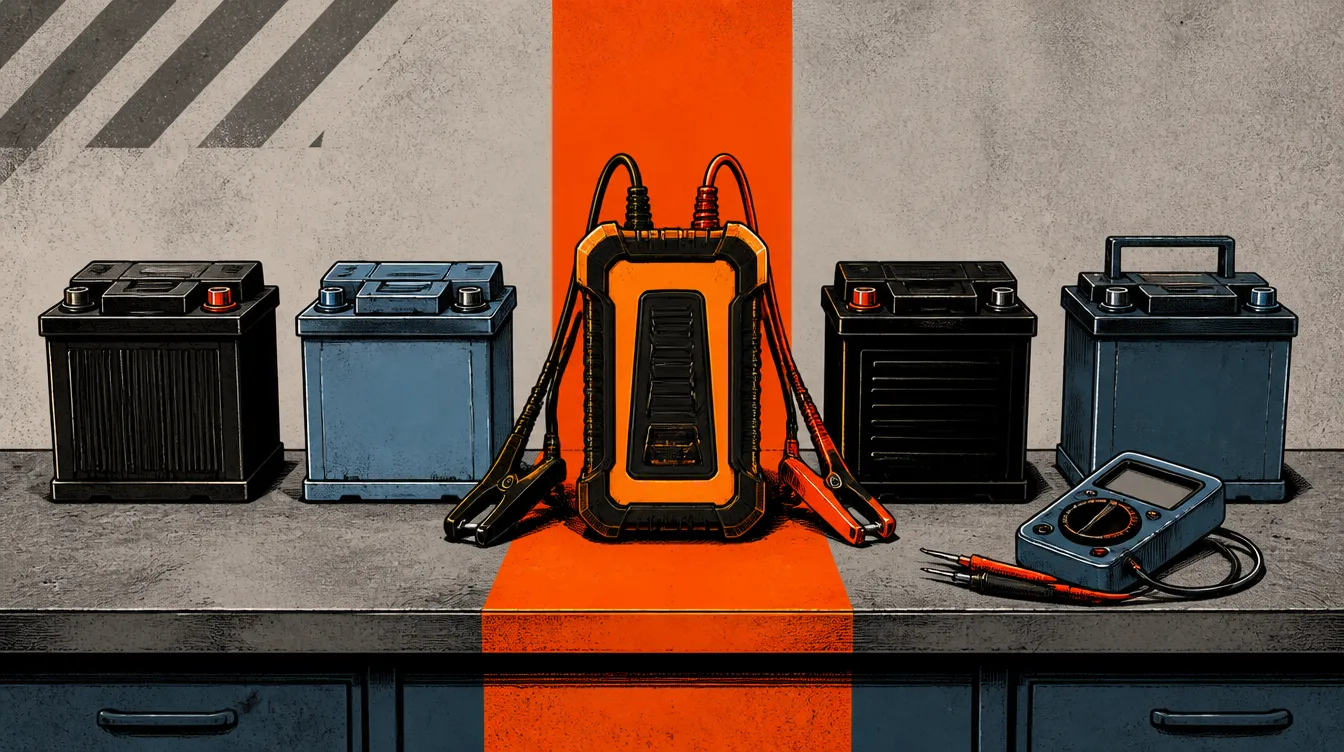
This head-to-head test of 5 car battery restoration options has the measured results for each. See how they ranked and watch the full test video.
Duralast
Affiliate link. We may earn a commission at no extra cost to you.
The measured results
Every number below is read straight from the test. Products are listed in the order they finished.
Restoration Method
- 1Duralast
stick welder (Harbor Freight titanium 225 inverter welder, about $320), 6 charge cycles of 5 minutes each at 70 to 85 amps with cooldowns between cycles
- 2Autocraft
stick welder at a higher 100 amps (versus 70-85 amps used on the other batteries), 6 charge cycles with cooldowns between cycles
- 3unnamed battery, approximately 12 years old
battery desulfator gadget, about $20, sends a continuous 2-amp pulse through the battery; tested again after nearly a week
- 4unnamed battery, approximately 8 years old
Epsom salt: battery acid drained, neutralized with baking soda and water, flushed with distilled water, refilled with an Epsom salt and distilled water mix, then charged for 12 hours; when that failed, the battery was also zapped with the stick welder for 6 cycles as a follow-up
- 5unnamed battery from an old Ford Ranger, over 10 years old, badly sulfated
stick welder, 6 charge cycles, followed by an overnight manual battery charger session at 10 amps
Before
- 1Duralast204 cranking amps
(tester recommends replacement), state of health 21%, internal resistance 19.05, all cells below 1.2 specific gravity, load test around 200 amps
- 2Autocraft
only 62 cranking amps, state of health 6% (the worst of all 5 batteries tested), internal resistance 62.5 (the worst of all 5), one cell (cell five) reading very low on the hydrometer
- 3unnamed battery, approximately 12 years old714 cranking amps
state of health 64%, internal resistance 5.72 milliohms, cells at specific gravity 1.24 to 1.25, voltage 12.7
- 4unnamed battery, approximately 8 years old599
to 600 cranking amps, state of health 50%, internal resistance 6.79 milliohms, voltage 12.7
- 5unnamed battery from an old Ford Ranger, over 10 years old, badly sulfated7.3 volts
would not hold a charge, essentially unusable
After
- 1Duralast446 cranking amps
state of health 46%, internal resistance 9.01, hydrometer readings improved to roughly 1.19 to 1.25 across cells, load test started around 600 amps and dropped to about 425 amps after 8 seconds
- 2Autocraft961 cranking amps
close to its full 1,000 rating, state of health 81%, internal resistance 4.26 (the best final internal resistance of all 5 batteries), load test dropped to about 900 amps
- 3unnamed battery, approximately 12 years old613 cranking amps
(worse than before), internal resistance 6.63 (worse than before)
- 5unnamed battery from an old Ford Ranger, over 10 years old, badly sulfated424 cranking amps
on the electronic tester (still recommends replacement), state of health 46%, internal resistance 9.47; load tester showed a better result, starting at 800 amps and dropping to about 600 amps after 10 seconds, described as 'pretty good shape'
- 4unnamed battery, approximately 8 years oldnot tested
Rating
- 1Duralast825 cranking amps
660 cold cranking amps
- 2Autocraft1,000 cranking amps
4 years old
- 3unnamed battery, approximately 12 years old930 cranking amps
- 4unnamed battery, approximately 8 years oldnot tested
- 5unnamed battery from an old Ford Ranger, over 10 years old, badly sulfatednot tested
All measurements (3 more)+
Real World Test
- 2Autocraft
successfully spun over Cousin Eddie's Farmall B tractor with a big block 454 engine for about 13 seconds; checked again after sitting overnight and was still holding a charge, performing as well as the day before
- 5unnamed battery from an old Ford Ranger, over 10 years old, badly sulfated
successfully started the Ford Ranger 5 times back to back; however, when checked again the next day the battery had already dropped to just over 10 volts and was described as still in bad condition
- 1Duralastnot tested
- 3unnamed battery, approximately 12 years oldnot tested
- 4unnamed battery, approximately 8 years oldnot tested
After Epsom Salt
- 4unnamed battery, approximately 8 years old51 cranking amps
(much worse), voltage dropped to 11.21, internal resistance 74.4 (much worse)
- 1Duralastnot tested
- 2Autocraftnot tested
- 3unnamed battery, approximately 12 years oldnot tested
- 5unnamed battery from an old Ford Ranger, over 10 years old, badly sulfatednot tested
After Welder Followup
- 4unnamed battery, approximately 8 years oldroughly59 amps
on the electronic tester; load test started around 600 amps and dropped to just over 200 amps
- 1Duralastnot tested
- 2Autocraftnot tested
- 3unnamed battery, approximately 12 years oldnot tested
- 5unnamed battery from an old Ford Ranger, over 10 years old, badly sulfatednot tested
How it was tested
- baseline diagnostics on each battery: electronic battery tester (Foxwell BT705) for cranking amps, state of health (SOH), and internal resistance; hydrometer readings of electrolyte specific gravity per cell; a load tester applying an actual electric load
- restoration via stick (arc) welder applying repeated 5-minute charge cycles at 70 to 100 amps with cooldown periods between cycles
- restoration via a low-cost electronic battery desulfator applying a continuous 2-amp pulse over roughly a week
- restoration via draining the battery, neutralizing acid with baking soda, and refilling with an Epsom salt and distilled water solution
- real-world test of restored batteries starting actual vehicles/engines (a Ford Ranger and a Farmall B tractor with a big block 454)
- overnight charge-retention check on the two best-performing restored batteries
“the welder helped the other three batteries and in one case made the battery about as good as new. So, I have to admit, I'm really surprised that the process actually works.”